
The Buyer Trap Every Audit Product Falls Into
If you're building any kind of audit, report, or "here's what's wrong" product — for SEO, accessibility, security, performance, anything — there's a buyer trap waiting for you. The person whose data shows up in the report is usually not the person who pays for it. I walked straight into that trap with GrowthMap, my first AI product build, and this is the elimination process that got me out.
GrowthMap started as a keyword gap report. Find a local business's missing search opportunities, hand them a report, done. Clean idea. Wrong buyer — twice, before I found the right one.
The first version was data, not a decision
Early validation said keyword gaps were interesting. People on Reddit liked the idea of seeing what they were missing. So I built toward that: pull keyword volume, CPC, competition data, generate a report.
Then I asked the question I should have asked first: so what? If a business's ranking moves from page 4 to page 2, who actually cares enough to pay for that? Ranking isn't the real goal anymore — AI overviews, Google's local pack, and FAQs sit above organic results before a searcher even sees a ranked link. A report about ranking position is generic advice. Generic advice doesn't sell.
Buyer #1: the local business owner — ruled out
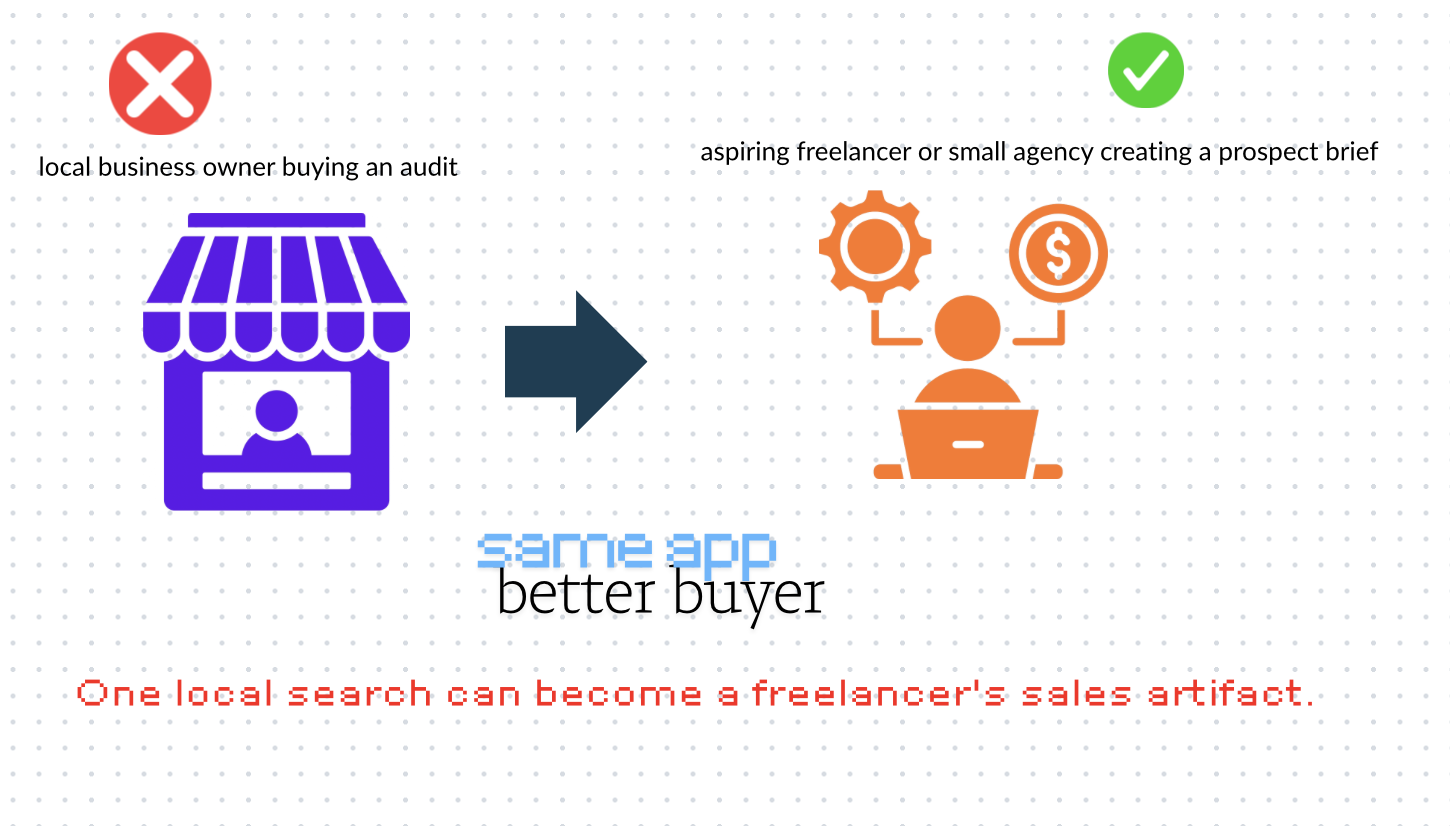
The obvious buyer for a "here's what's wrong with your visibility" report is the business itself. Except local business owners don't buy audit reports. An audit doesn't make them money — it tells them a problem exists. They want it fixed, not described. It's the equivalent of sermonising when you aren't fixing the problems.
Buyer #2: the agency — also ruled out
Agencies already sell visibility work. They have tracking tools, citation monitoring, recurring retainers. A small audit report isn't a product to them — it's a feature their existing stack already covers, badly undersold at any price I could charge.
Buyer #3: the freelancer or solo operator — this is it
The actual buyer is someone trying to get in the door with a business — a freelancer learning local SEO, a solo marketer, someone on Upwork building a local agency. They don't need an audit for themselves. They need a credible artifact to hand a stranger: "I found these three gaps on your site. Want to fix them?"
That's not an audit product. That's a sales artifact. One local search becomes one freelancer's foot in the door.
What actually changed
The product didn't change as much as my filter did. I went back through funnel research — service-page optimization, AI citations, zero-click search, Search Console signals — not to add features, but to find where someone would pay and why. That filter is what eliminated buyers #1 and #2 and pointed at #3.
The pricing followed naturally: one free report to start, then a small per-report fee — the freelancer can pass that cost to their client, or use the free report itself as the opener, then upsell fixing the gaps.
The lesson for past-me
Don't freeze the design until the buyer is specific. Not "local businesses" — which buyer, with which pain, which existing alternative, and why would they hand over money instead of doing nothing. If you can't answer that in one sentence, the design isn't ready, no matter how clean the architecture is or how beautiful the UX looks or or how sophisticated the tech is.
If you're building a data or report-shaped product right now: ask who's actually paying before you ask what the report should say. The subject of the report and the buyer of the report are rarely the same person.
Full walkthrough — the funnel research, the elimination process, and my full build log for GrowthMap in my channel https://www.youtube.com/@Pankstr
Source code and build notes: https://www.pankstr.com/drop
Want to talk through what this means for your business?
Book a 20-minute call →